A Shiny-like dashboard prototype for Clojure
Hiccup is a concise way to describe a graphical user interface as a tree.
(let [size 400
      size2 (/ size 2.0)
      size25 (/ size 2.5)
      size3 (/ size 3.0)]
  ^:kind/hiccup
  [:svg {:style {:width "100%", :height :auto}
         :viewBox [0 0 size size]
         :role "img"
         :aria-label "yin-yang"}
   [:rect {:fill (color/palette 1) :width size2 :height size}]
   [:rect {:fill (color/palette 4) :x size2 :width size2 :height size}]
   [:rect {:fill (color/palette 2) :x (- size2 size25) :y (- size2 size25) :width (* size25 2) :height size25}]
   [:rect {:fill (color/palette 5) :x (- size2 size25) :y size2 :width (* size25 2) :height size25}]
   [:circle {:fill (color/palette 3) :r size3 :cx size2 :cy size2}]])
Interactive UIs also need a way to connect controls to state and events. Shiny, an R framework for building interactive web applications, does this through reactive programming. When inputs change, dependent outputs update automatically. What if we could achieve something similar in Clojure with a small set of conventions? The goal is a similar server-side dashboard experience, not a reproduction of Shiny’s reactive model.
When a control changes, Datastar sends the current signal values to Clay. A button can also send a one-request event. The UI function reads that state and returns Hiccup with controls bound to state keys.
(defn greet [{:keys [a b]}]
  [:col
   [:strong (str "Hello: " a ", " b)]
   [:row
    [:input {:name :a}]
    [:input {:name :b}]]])
A UI is a function of state. The greet function takes :a and :b from state to make a greeting. The two inputs use those same keys in their :name attributes. This function can be used to set up a reactive UI. Clojure renders the HTML on the server; Datastar updates the browser DOM. (We’ll see what that looks like later in the notebook…)
Let’s make a more compelling UI:
(def penguins
(tc/drop-missing (rdatasets/palmerpenguins-penguins)))(def column-names
(mapv name (tc/column-names penguins)))(defn penguins-ui [{:keys [x y color-by click]
:or {x (get column-names 6)
y (get column-names 3)
color-by (get column-names 1)}
:as state}]
(let [swap (= click :swap-axis)
[x y] (if swap [y x] [x y])
signals (cond (empty? state) {:x x :y y :color-by color-by}
swap {:x x :y y})]
[:div.card (when signals {:data-signals signals})
[:div.card-header "Penguins"]
[:style ".plotje-plot {width:100%; height:auto}"]
[:div.card-body
[:div.container
[:row
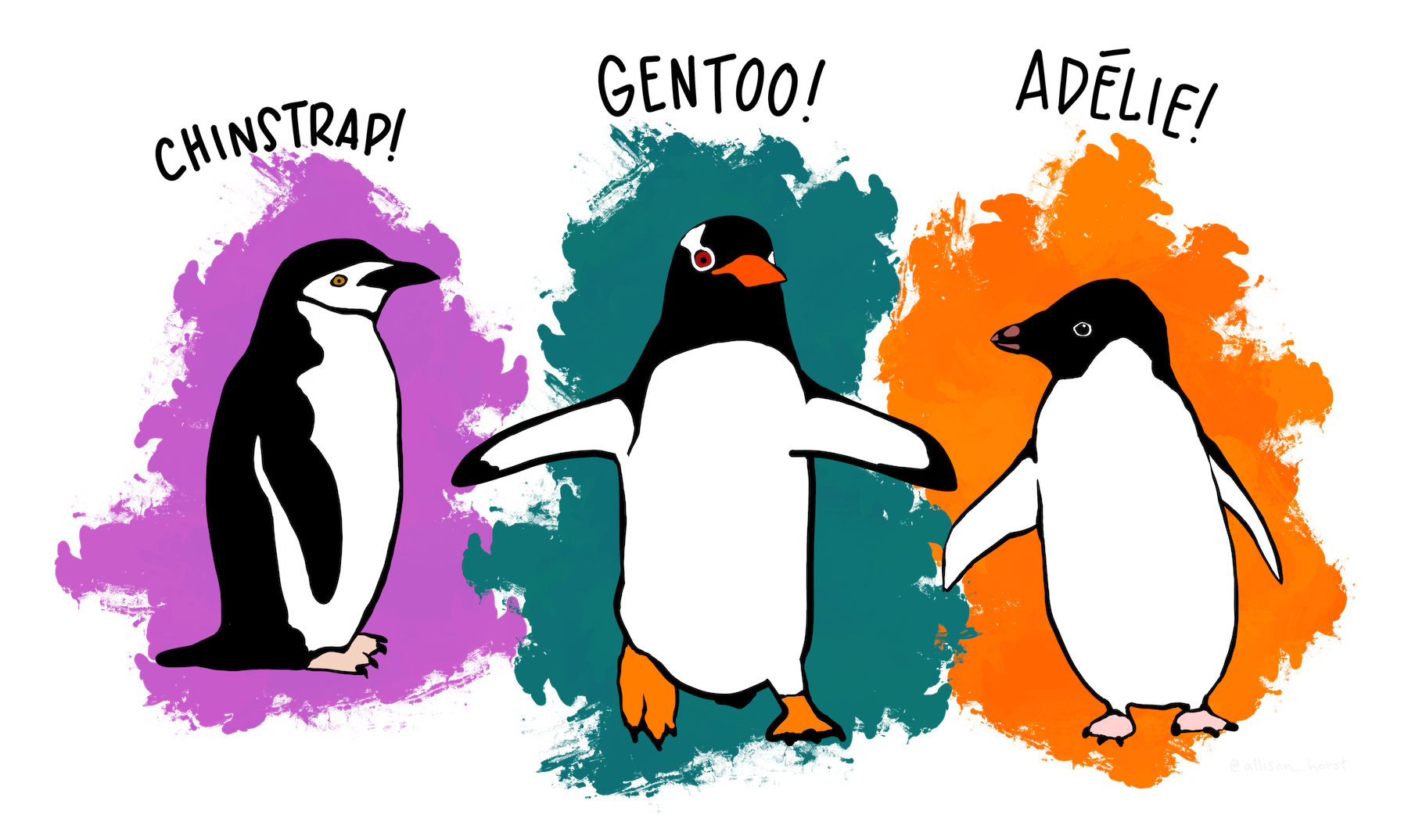
^:kind/md ["Observations of *three penguin species* in the Palmer Archipelago, Antarctica.
The data was collected by Dr. Kristen Gorman at the Palmer Station Long Term Ecological Research (LTER) network."]
[:img {:src "https://allisonhorst.github.io/palmerpenguins/reference/figures/lter_penguins.png"
:alt "Illustration of penguins from the Palmer Archipelago"
:style {:width "200px"
:height :auto}}]]]
[:row
[:select {:name :y, :label "y-axis", :options column-names}]
[:col
(try (-> (pj/pose penguins (keyword x) (keyword y)
{:color (when (not (str/blank? color-by))
(keyword color-by))})
(pj/plot))
(catch Exception ex ex))
[:select {:name :x, :label "x-axis", :options column-names}]
[:button {:name :swap-axis} "Swap x/y"]]
[:col
[:select {:name :color-by :label "color-by" :options (cons "" column-names)}]]]]]))Treating UI components as functions is familiar. The difference here is that browser state, when changed, is implicitly passed to a server function, which returns the next UI. This hides most of the request-and-response plumbing.
Buttons can send one-off events as well as controls sending state. Clicking the swap button adds :click with the value :swap-axis to that request only. The UI function handles the event during that render and returns the chart with its axes swapped. No separate per-button handler is needed; the new axis choices become UI state.
A control changes
→ the browser sends state (and any one-off event)
→ the Clojure function returns Hiccup
→ Datastar updates the page.
Implementation
How can we turn a function into a UI? The uije function is defined in this namespace you are reading right now, we’ll get to the details of what it does soon. In the future we might create a library with a more complete implementation, and possibly include it with Clay.
Datastar is a JavaScript library that updates the DOM from server responses. The server sends HTML, and Datastar morphs the existing UI to match it. The first thing we will need to do is include the JavaScript, and set up some state change calls to an endpoint we will create.
(defn datastar-root [id endpoint]
  [:div {:id id
         :data-on:input (str "@post('" endpoint "')")
         :data-on:change (str "@post('" endpoint "')")}
   [:script {:type "module"
             :src "https://cdn.jsdelivr.net/gh/starfederation/datastar@v1.0.4/bundles/datastar.js"}]])
We add the Datastar syntax during rendering so that the UI function doesn’t need it. To enhance the Hiccup, we walk the tree:
(defn branch? [x]
  (and (vector? x)
(keyword? (first x))))(defn enhance-attrs [attrs]
(cond-> attrs
(contains? attrs :data-signals)
(update :data-signals json/write-json-str)))(defmulti enhance-tag (fn [tag attrs endpoint] tag))(defmethod enhance-tag :default [tag attrs endpoint]
(if attrs
[tag attrs]
[tag]))(defn enhance-hiccup [node endpoint]
(if (branch? node)
(let [[tag & [x & more :as xs]] node
attrs (when (and (map? x)
(-> {:value x} kindly-advice/advise :meta-kind not))
(enhance-attrs x))
children (if attrs more xs)]
(-> (enhance-tag tag attrs endpoint)
(into (map #(enhance-hiccup % endpoint) children))))
node))(defn clojurize [query-params]
(-> query-params
(update-keys keyword)
(update-vals edn/read-string)))The Main Entry Point
And here is the function to create a UI from a function. It creates (or updates) an endpoint, enhances the Hiccup and adds the Datastar script.
(defn uije
  "Makes a UI from a var or function that accepts state, and returns hiccup."
  [ui-var]
  (let [id (or (some-> ui-var meta :name) "uije-app")
        endpoint (str "/uije/" id)
        ;; Wrap the UI to make it a datastar app
        ui-fn (fn [state]
                (-> (ui-var state)
                    (enhance-hiccup endpoint)
                    (->> (conj (datastar-root id endpoint)))
                    (kind/hiccup)))
        ;; Install a handler to listen to datastar posts which contain state,
        ;; re-renders the UI with that state,
        ;; Datastar will then morph the DOM to the new UI.
        endpoint-var (intern *ns* (symbol (str id "-endpoint"))
                             (fn [{:keys [request-method uri query-params body-params]}]
                               (when (= uri endpoint)
                                 {:status 200
                                  :headers {"Content-Type" "text/html; charset=utf-8"}
                                  :body (-> {:value (ui-fn (merge body-params (clojurize query-params)))}
                                            (prepare/hiccup 2)
                                            (:html)
                                            (str))})))]
    (server/install-handler! endpoint-var)
    ;; Initial render with no state, Clay will put this in the page.
    (ui-fn nil)))
Hiccup Enhancement
Enhancing allows custom properties to expand into larger hiccup blocks:
(defmethod enhance-tag :input [_ {:as attrs :keys [name label]} endpoint]
  (cond->> [:input.form-control (cond-> {}
                                  name (assoc :data-bind name)
                                  name (assoc :id name)
                                  true (merge (dissoc attrs :label)))]
    (and name label) (conj [:div.mb-3
                            [:label.form-label {:for name} label]])))
The important part here is that :data-bind was set to the name of the input. This is a Datastar attribute called a signal.
(defmethod enhance-tag :select [_ {:as attrs :keys [name options label]} endpoint]
  (cond->> [:select.form-select (cond-> {}
                                  name (assoc :data-bind name)
                                  name (assoc :id name)
                                  true (merge (dissoc attrs :options :label)))
            (for [c options]
              (if (vector? c)
                [:option {:value (first c)} (second c)]
                [:option {:value c} c]))]
    (and name label) (conj [:div.mb-3
                            [:label.form-label {:for name} label]])))
We can provide options more compactly as a custom attribute.
For buttons, we wish to know that a click occurred, rather than receiving a state. Events are sent as query params (which are transient), rather than data-bind (which create state).
(defmethod enhance-tag :button [_ {:as attrs :keys [name]} endpoint]
  [:button (cond-> {}
             name (assoc :data-on:click (str "@post('" endpoint "?"
                                             (codec/form-encode {"click" name})
                                             "')"))
             true (merge attrs))])
We can add custom tags like :row and :col:
(defmethod enhance-tag :row [_ {:as attrs :keys [name]} endpoint]
[:div (kindly/deep-merge {:style {:display :flex}} attrs)])(defmethod enhance-tag :col [_ {:as attrs :keys [name]} endpoint]
[:div (kindly/deep-merge {:style {:display :flex :flex-direction :column}} attrs)])The main point of enhancement is that a simple, expressive UI DSL can expand into styled, interactive components. One possibility is to render the same DSL through different backends, perhaps including Membrane. A separate possibility is to use Membrane’s own UI model directly. What would each approach require, and could they share any state and event conventions? We’d like users not be required to learn web development to create a polished interface. Instead, the basic representation should stay simple and allow additional enhancements.
The Result
The controls will only be responsive if you are running this notebook locally. Running this notebook sets up the Clay server to listen to and respond to the client with UI updates. The browser sends input changes to an endpoint hosted by Clay. Clay renders the UI on the server, and Datastar applies the returned HTML in the browser. To run this notebook, clone the ClojureCivitas repository, and run Clay inside the clojurecivitas.github.io directory:
clojure -M:clay src/scicloj/clay/ideas/uije2.cljOr call “Clay Make File” using your favourite editor integration.
(uije #'greet)(uije #'penguins-ui)Observations of three penguin species in the Palmer Archipelago, Antarctica. The data was collected by Dr. Kristen Gorman at the Palmer Station Long Term Ecological Research (LTER) network.
Server-rendering is not for everyone
Sometimes it is useful to package a UI as a self-contained browser-side component. For some applications, an entirely browser-side experience is a better fit. Supporting that could be another goal.
Clay already works great with Reagent and Replicant (via Scittle Kitchen). It would be interesting to see whether opinionated state and event conventions could make them easier to use for small dashboard-style experiences.
State and event handling are key abstractions for Shiny-like dashboards. Clojure and ClojureScript offer flexible ways to express them, but how can we represent interactive behavior in a way that can be preserved across rendering environments, such as web pages, notebooks, and desktop applications?
In this post, we propose a convention worth exploring:
- App state lives on the client.
- The render function receives the full app state, rather than isolated component state.
- Transient interactions create temporary state.
- The render function can return updated state alongside the UI.
Conclusion
This prototype explores how a custom Clay kind could provide a Shiny-like dashboard experience for Clojure. It would define conventions for transferring state between the browser and server, and enhance Hiccup controls with the bindings and events needed for interaction.
source: src/scicloj/clay/ideas/uije2.clj