A Survival Themed Probability Cheatsheet Zine
Will You Survive?
Island Survival Guide
You are stranded on an island. The difference between rescue and disaster lies in the data. This is your survival guide to probability and statistics. Learn the patterns, and maybe you will get rescued.
This page is a companion to a printable foldable zine. See the PDF to view the 8-panel print layout.
Enumerate and count
\(P(E) = \frac{\text{favorable outcomes}}{\text{total outcomes}}\)
Check 10 nearby trees. Count the outcomes you care about, then divide by the number of trees. Enumeration means listing possible outcomes so you can count them.
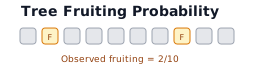
You sampled 10 trees, but the island has over 100 trees. So \(\frac{2}{10}=0.2\) is a sample-based guess: useful for describing what you observed and predicting future observations.
Statistics use past observations (like 2 of 10 trees) to estimate a probability. Probability uses that estimate to predict what will happen at the next tree. Probability rules show how to combine predictions into complex scenarios.
The AND Rule
\(P(A \text{ and } B) = P(A) \times P(B)\)
You make two foraging stops before dark; how much fruit should you expect? Linked events shrink your chances; multiply the probabilities along the branches. Each requirement filters out more possibilities, so you need both to happen.
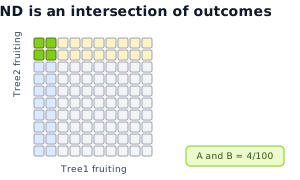
If each tree has fruit chance \(2/10\) (0.2), then \(P(\text{tree1 fruiting AND tree2 fruiting}) = 0.2 \times 0.2 = 0.04\) (4%).
The OR Rule
\(P(A \text{ or } B) = P(A) + P(B)\)
It’s a new day! Time to collect more fruit. A tree can be a coconut tree or a bananna tree, but not both at once. When you visit a tree, the type of tree is mutually exclusive.
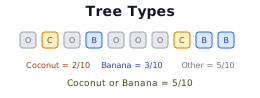
A tree cannot be both types at once, so just add the probabilities. \(P(\text{coconut or banana}) = \frac{2}{10} + \frac{3}{10} = \frac{5}{10} = 0.5\).
If categories can overlap, adding \(P(A)\) and \(P(B)\) counts shared cases twice. Subtract the overlap once to fix that double-counting. Use \(P(A \text{ or } B)=P(A)+P(B)-P(A \text{ and } B)\).
tall or fruiting = tall + fruiting - tall and fruiting.
The NOT Rule
\(P(\text{not } E) = 1 - P(E)\)
Night is coming; you need to find at least one fruit. If you visit 3 trees with \(P(fruit)=\frac{2}{10}\), what is the chance you get at least one fruit? Use the NOT rule when the event you want is hard to count, but its opposite is easy.
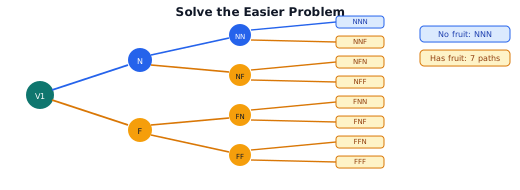
\(P(not fruit) = 1 - \frac{2}{10} = \frac{8}{10}\)
\(P(\text{no fruit in 3 trees}) = \frac{8}{10}\times\frac{8}{10}\times\frac{8}{10} = 0.512\).
Invert back to the original question:
\(P(\text{at least one fruit}) = 1 - 0.512 = 0.488\).
The “Given That” Rule
\(P(A \mid B) = \frac{P(A \text{ and } B)}{P(B)}\)
The bar symbol \(|\) means “given”.
Dark clouds move in, so your wood-gathering plan must adapt to the weather you actually get. Question prompt us to gather new statistics and probabilities.
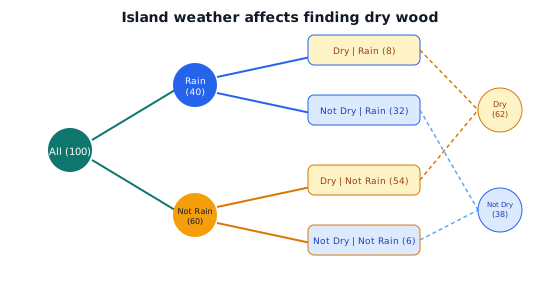
Probability is about identifying the interesting set of outcomes. A tree helps you enumerate and count interesting and possible outcomes. For “dry wood given rain,” count within rainy outcomes: \(8/40\). For “rain given dry wood,” count within dry outcomes (all yellow): \(8/62\). It’s a matter of filtering to cases where the condition is true, then count outcomes inside that filtered group.
Distribution Matters
Where will you camp? Continuous variables like temperature can be any value. Observations rarely spread evenly; instead, they cluster and vary. Island A and Island B both average 75°F, yet Island A is highly predictable (72°F to 78°F) while Island B is highly volatile (30°F to 120°F). To truly understand the situation, we must see the distribution, the shape of the data.
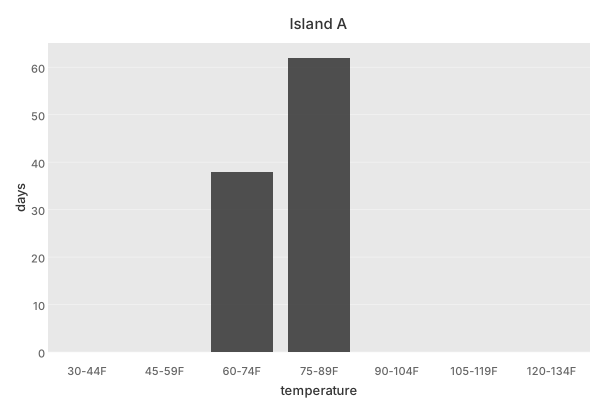
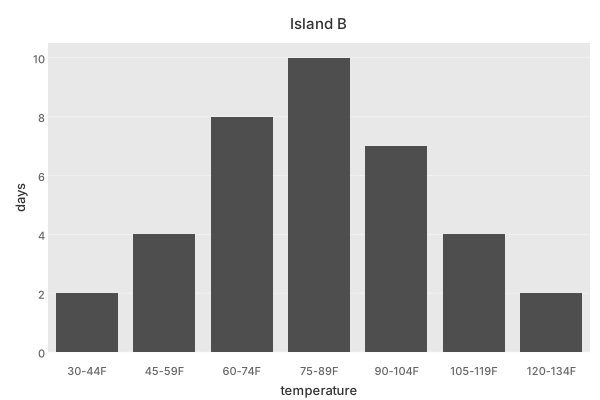
A distribution reveals where observations cluster and how frequently they occur. Variance quantifies this spread by measuring the average squared distance from the mean. A wider spread generally implies higher variance, but the exact value depends on the range and the shape of the distribution.
Survival Quiz

Time to try to use your radio to contact help.
- Your radio has a \(\frac{2}{3}\) failure rate. What is the probability that your signal is successful?
- Finding fruit and using the radio are independent events. If fruit is found \(\frac{2}{10}\) of the time and the radio works \(\frac{1}{3}\) of the time, what is the probability that both happen?
- Rainfall data shows most days have 0 mm of rain, but one rare day has a 600 mm flood. How would you describe the shape of this distribution?
- Land Area A has a height standard deviation of 2 ft (very flat). Land Area B has a height standard deviation of 80 ft (very rugged). Which area is more likely to contain a mountain peak?